Page name

European Life Sciences Coalition: Why ELSC Could Reshape European Innovation Funding
By Corey Ogden
Over the past 12–18 months, many of my conversations with founders, investors and board-level leaders across European life sciences have focused on funding.
The science is strong; the ambition is there. What’s been harder is scaling within Europe itself.
Europe continues to produce world-class research and commercially viable biotech. Yet it captures only 7% of global life sciences VC funding, compared with 63% in the US and 14% in China. That funding imbalance shapes real decisions around where companies raise, list and build long-term leadership teams.
The formation of the European Life Sciences Coalition (ELSC) reflects that backdrop, bringing together leading investors to disrupt how capital is mobilised in Europe’s most innovative sectors.
Nine founding members (including Sofinnova Partners and Novo Holdings, working alongside Invest Europe) collectively manage more than €24bn in life sciences-focused assets and have backed over 1,400 companies.
The question now is whether coordinated capital can begin to close a structural gap that Europe has been discussing for years.
Europe’s Life Sciences Funding Gap
Europe produces strong science and remains a major pharmaceutical exporter, reaching €313.4bn in 2024.
The structural weakness lies in capital depth.
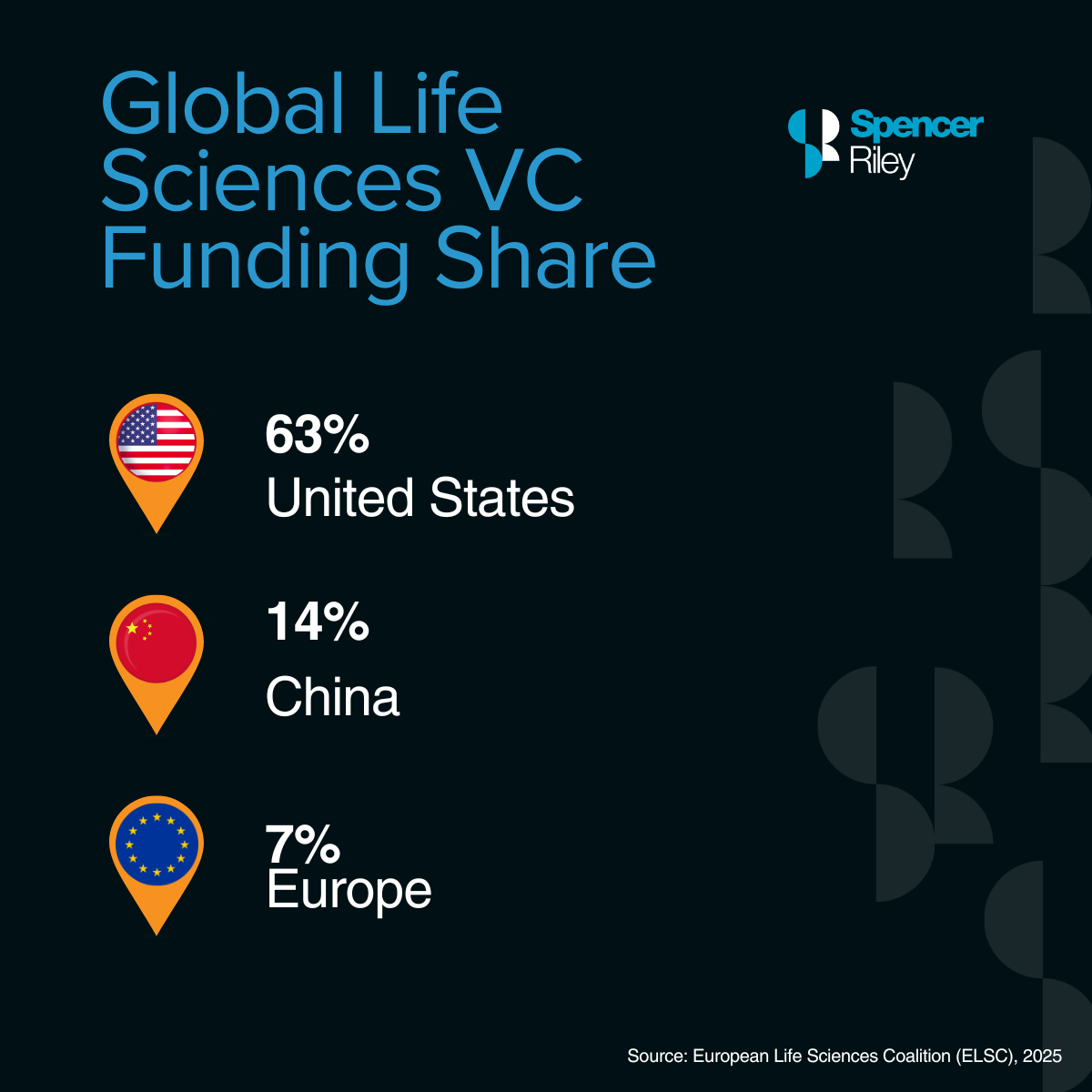
That imbalance influences where companies list, where they scale and where long-term investor support sits.
Relocation is rarely ideological; it reflects liquidity, funding continuity and access to growth capital.
For deep tech and biotech businesses, scale funding determines whether Europe is the long-term base or the early-stage launchpad.
How the European Life Sciences Coalition (ELSC) Could Change Biotech Funding in Europe
What’s interesting about the European Life Sciences Coalition is not just the capital behind it, but the signal it sends.
In conversations with investors, there’s increasing acknowledgement that fragmentation has held Europe back. National markets have operated in parallel rather than in alignment. Early-stage funding is often strong; later-stage growth capital has been thinner.
The ELSC appears designed to address that structural weakness.
Here’s what that could mean in practical terms.
1. More Coordinated Venture Capital Funding Across Europe
European VC has often required companies to stitch together funding across multiple markets. A coalition model creates shared strategic intent across major funds.
For founders, that reduces friction between stages. For boards, it introduces clearer continuity from Series A through to growth rounds.
2. Addressing Europe’s Late-Stage Biotech Capital Shortage
Many leadership teams I speak to see US capital markets as the default for late-stage liquidity. Not because they want to leave Europe, but because depth of capital often dictates the move. If the coalition succeeds in mobilising institutional and sovereign capital at scale, that dynamic could start to shift.
3. Aligning European Policy with Life Sciences Investment
The coalition has indicated it wants to bring market-driven perspectives into policy discussions. In parallel, the European Commission’s proposed Biotech Act aims to accelerate lab-to-market timelines.
Alignment between regulation and capital deployment is not guaranteed, but when it happens, scaling becomes more predictable.
4. Why the ELSC Sends a Confidence Signal to Global Investors
Capital follows conviction. When investors managing €24bn align publicly around a shared objective, it sends a message beyond Europe. It signals that European life sciences is organising, not retreating.
For executive teams considering hiring plans, expansion or cross-border growth, that confidence signal has real influence.
Why the European Life Sciences Coalition Matters for Deep Tech Europe
The European Life Sciences Coalition shouldn’t be viewed solely as a biotech initiative.
Life sciences businesses are complex and expensive to build. They take time, require specialist expertise and need patient capital. The same is true in areas like climate technology, advanced manufacturing and AI-driven healthcare.
If investors can align around a clearer funding model in life sciences, that approach could extend into other high-growth sectors facing similar challenges.
Europe produces strong science. The difficulty has been turning that research into companies that scale and remain anchored in European capital markets.
What the ELSC Means for Leadership, Hiring and Scaling in European Life Sciences
A large part of our work at Spencer Riley focuses on leadership decisions made alongside funding milestones.
When companies raise growth capital or prepare for expansion, the leadership brief changes. Boards look for CFOs who understand investor scrutiny. CEOs need commercial leaders who have scaled in regulated markets. The bar shifts.
We work with life sciences and deep tech businesses at that point where capital plans and leadership capability need to align.
The European Life Sciences Coalition does not solve Europe’s funding gap overnight. It does, however, show that leading investors recognise the structural issue and are willing to coordinate around it.
Will the European Life Sciences Coalition Close Europe’s Capital Gap?
Are we seeing larger growth rounds completed in Europe?
Do more European biotechs choose to list locally?
Does institutional capital step in at later stages?
Those are the indicators that will tell us whether the coalition has translated alignment into tangible capital flows.
For founders, investors and senior leaders building in European life sciences and deep tech, this is worth watching closely.
The conversation around European innovation is becoming more coordinated. If capital mobilisation follows through, the environment for scaling ambitious science businesses could become more stable and more confident.
Connect with Spencer Riley to discuss trends shaping the future of European innovation.
Follow us on LinkedIn for more insights on life sciences and deep tech growth in Europe.

Related Insights






Contact us today
Spencer Riley’s team of highly dedicated, specialist consultants’ pride themselves on gaining a full understanding of our client’s business,