Page name
Hiring across the global chemicals market is harder now than it was 18 months ago.
Across coatings, adhesives, sealants, elastomers, polymers, and specialty chemicals, demand for experienced technical talent continues to outpace supply. I work across US chemicals clusters in the Gulf Coast, the Midwest, the Southeast, and the West Coast, alongside European hubs in the Rhine corridor, the Antwerp-Rotterdam belt, and Northwest England, and the pressure is consistent across all of them.
At the same time, AI-enabled manufacturing and automation are adding another layer of pressure on an already tight talent market.
Why chemicals recruitment remains a niche, specialist market
One of the biggest challenges in chemicals recruitment is how niche the market really is.
Across formulation, R&D, technical sales, process engineering, and operations leadership, companies are looking for highly specific experience tied to particular chemistries, applications, or product categories.
That makes crossover far more limited than many businesses expect.
A coatings specialist doesn't always move naturally into adhesives. Someone with experience in specialty polymers may not fit seamlessly into elastomers or sealants. Even within technical sales, product knowledge and application understanding still matter heavily.
Most of the senior people I place are not actively looking when I first speak to them. When they do move, they're usually weighing multiple opportunities at the same time.
Why counter-offers are becoming more aggressive across chemicals hiring
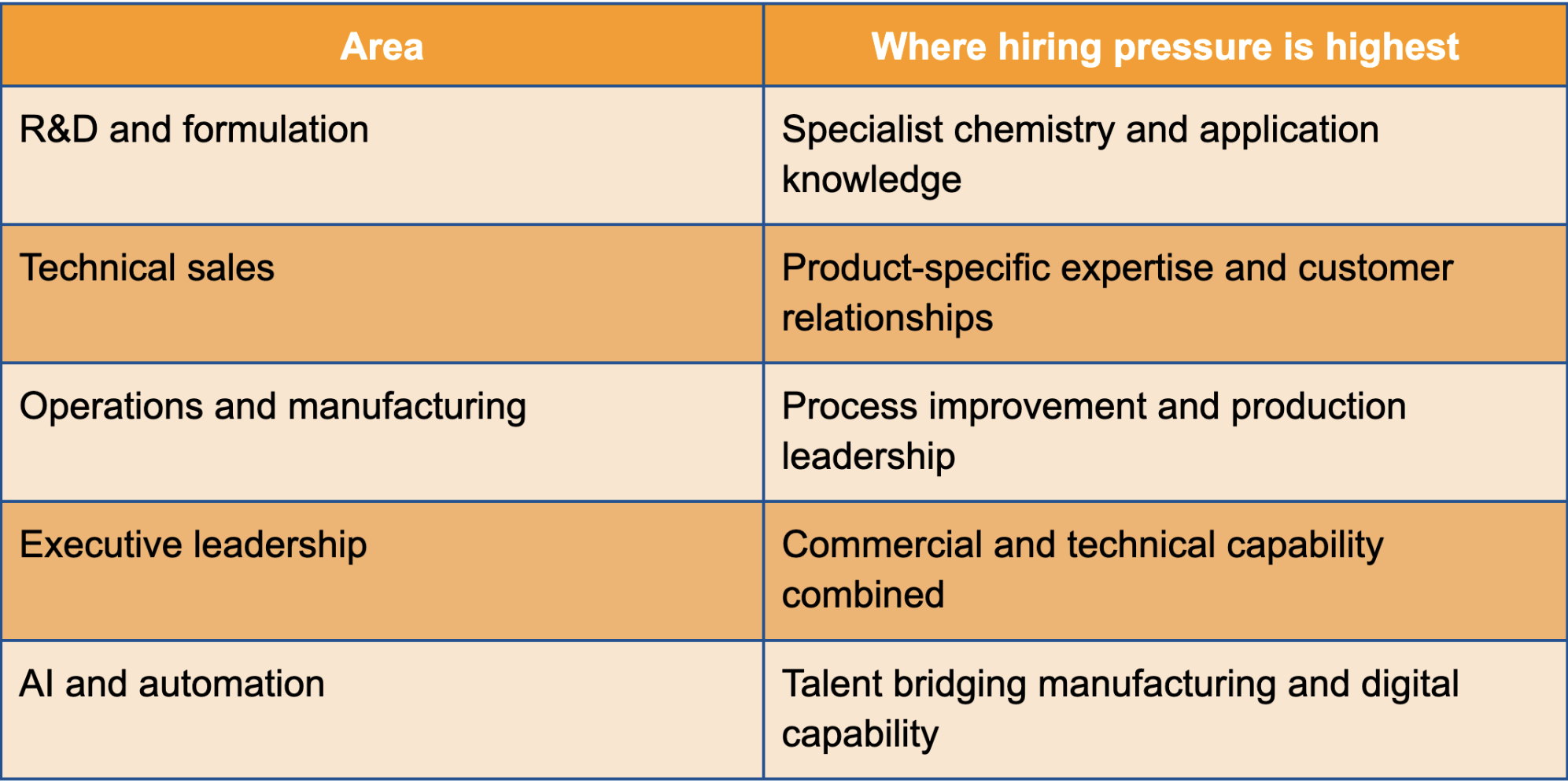
Companies know how difficult this talent is to place and replace. The roles I'm seeing businesses fight hardest to retain are:
- Formulation specialists
- Technical sales leaders
- Process engineers
- Operational leadership talent
- Commercially strong R&D professionals
Replacing a senior formulation chemist with niche application experience can take six months or more, particularly in adhesives and specialty coatings.
Replacing a technical sales lead with established customer relationships can take just as long, and the customer relationships themselves don't always transfer.
How AI is starting to reshape chemicals manufacturing capability
AI in chemicals manufacturing is still earlier than in some other sectors, but it's becoming a much bigger conversation across the market.
Companies are looking at how AI can support:
- Manufacturing efficiency
- Predictive maintenance
- Formulation optimisation
- Quality control
- Process automation
- Production planning
This exposes capability gaps inside existing teams. Many chemicals businesses still operate with highly experienced technical teams, but the combination of manufacturing expertise and digital capability remains relatively rare.
Across manufacturing more broadly, Deloitte's 2025 Smart Manufacturing Survey of 600 manufacturers found that 35% of executives cite adapting workers to the factory of the future as their top workforce challenge, and only 48% have a training and adoption standard in place.
In chemicals, where the technical baseline is already specialised, that gap is showing up faster than most businesses planned for.
Most of this upskilling is happening inside the business. There aren't really formal training routes for AI in manufacturing yet, certainly not at the scale this industry needs.
So, businesses want people who can grow as the market does.
Over the next few years, this will be the biggest hiring conversation in chemicals.
What chemicals businesses should focus on now
Don’t wait until hiring becomes urgent. Instead, work on:
- Strengthening retention for niche technical roles before counter-offers become the only response
- Moving faster on senior R&D and formulation hires, where six-month processes lose strong candidates to competitors
- Building succession plans for specialist chemistry roles where the talent pool is smallest
- Upskilling existing manufacturing teams in digital and AI capability, given the lack of formal pathways
- Mapping future capability gaps now, before AI-enabled manufacturing becomes urgent rather than emerging
Specialist chemicals hiring remains relationship-led and experience-driven. That isn't going to change. What's changing is the level of competition for proven technical talent and the pressure on businesses to adapt as manufacturing technology evolves.
Speak to Mark
If you're hiring across chemicals, adhesives, sealants, or specialty chemistry, or you're considering your own next move in the market, contact Mark Summers for a confidential conversation about where the market is heading.

Related Insights



Contact us today
Spencer Riley’s team of highly dedicated, specialist consultants’ pride themselves on gaining a full understanding of our client’s business,