Page name

Protein dominated the last decade of nutrition innovation. It became a permanent pillar of product development, tied to strength, performance, and visible results.
Now fibre is generating similar levels of attention across food, nutrition, and functional ingredients.
Recently, I sat down with Derek Buerkel, M.Sc. Food Science (University of Hamburg), to discuss why. Consumer awareness is growing, brands are investing more heavily in fibre, and product developers are finding new ways to formulate with it.
But is fibre really becoming the next protein?
Here are some of the questions we discussed and the insights that stood out.
How fibre became bigger than digestive health
For years, fibre sat in a relatively narrow corner of nutrition compared to protein, which became associated with performance, energy, and lifestyle.
Today, consumers expect more from it.
As Derek explained, the conversation has expanded beyond digestive health to include satiety, blood sugar stability, cholesterol management, metabolic health, and even the gut-brain axis.
The science has existed for decades and consumer awareness has finally started catching up.
Social media trends such as #fibermaxxing have helped bring fibre into mainstream wellness conversations. While they have undoubtedly increased awareness, the science behind fibre has been around for decades.
“The shift is from fiber as a passive nutrient to fiber as a foundational wellness tool, and that’s why it’s having such a moment.”
Why brands are paying more attention to fibre
Brands are paying attention because the opportunity is hard to ignore.
The European Food Safety Authority (EFSA) recommends adults consume 25–30g of fibre per day, while children and teenagers should aim for around 15g. Yet national dietary surveys across Europe suggest that between 60% and 80% of adults still fail to meet those recommendations. Some consume as little as 5g per day.
That creates a significant gap between recommended intake and real-world behaviour.
As Derek pointed out, simply adding more fibre is not the answer.
The brands succeeding in this space make fibre easier to incorporate into everyday routines rather than expecting consumers to completely change how they eat overnight.
Can fibre become the new protein?
Is fiber becoming the next protein? The short answer is no.
At least not if the question is whether fibre will replace protein.
“Instead of fiber replacing protein, the biggest opportunity could be products that elevate both together, but this will of course depend on the consumer needs.”
As Derek explained, the two nutrients solve very different physiological needs:
- Protein supports growth, repair, and performance.
- Fibre supports digestive function, satiety, blood sugar management, and broader metabolic health.
Protein has already earned its place as a hero nutrient. Fibre is now building its own position alongside it, particularly in categories such as snacks, breakfast products, and functional foods where consumers increasingly look for multiple benefits from a single product.
Derek expects fibre to become a much more prominent on-pack claim over the next five years, particularly across breakfast and snacking categories. Not because it replaces protein, but because consumers are becoming more aware of the role it plays in overall health and wellbeing.
What brands need to understand about fibre claims
One of the biggest challenges facing brands is the gap between what science supports and what regulations allow them to communicate.
Fibre claims are tightly regulated.
While research continues to explore fibre's relationship with areas such as metabolic health, cardiovascular health, and the microbiome, only a small number of fibre-related health claims are currently authorised within Europe.
Naturally, that creates confusion in the market.
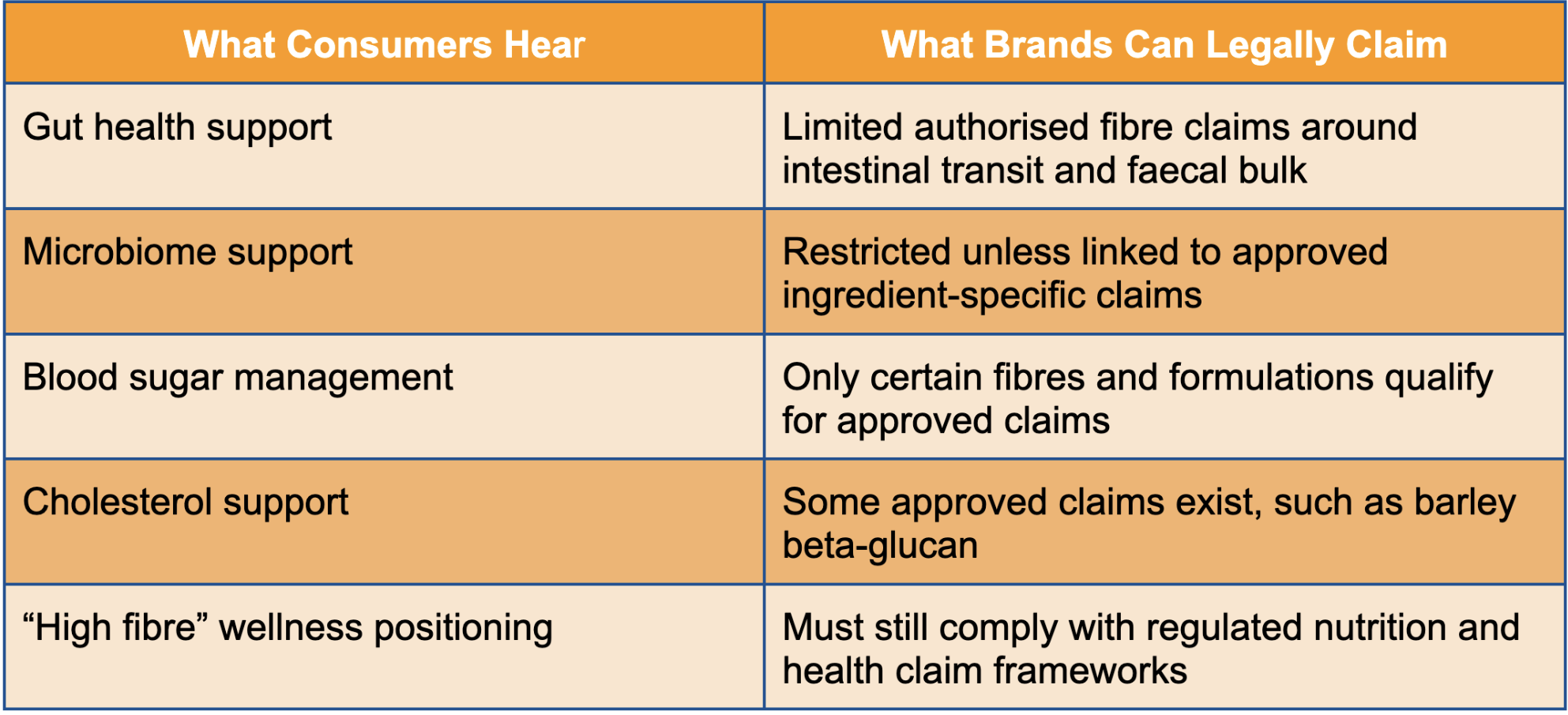
As Derek highlighted, most consumers do not understand the difference between authorised and non-authorised claims.
Brands that communicate clearly and formulate responsibly will earn trust far faster than those chasing claims they cannot substantiate.
“It is important for companies to understand their consumers and the functions of their brands, portfolios and products before innovating. Winners won’t be the ones who simply add fibre and slap “high fibre” on the pack.”
Why fibre formulation is more complex than it looks
Understanding fibre is one thing, formulating with it is another.
Adding fibre can affect texture, moisture management, flavour release, structure, shelf life, and processing performance.
Depending on the ingredient and application, formulators may encounter grittiness, bitterness, structural weakness, moisture instability, or digestive tolerance issues.
That is why successful fibre innovation requires more than simply increasing dosage levels.
Derek highlighted several ingredient areas attracting attention, including resistant starches, upcycled fruit and vegetable fibres, improved soluble corn fibres, and modified chicory root fibres.
Each offers different technical advantages depending on the product format and nutritional objectives.
Derek made a point that many brands still underestimate: more fibre does not automatically create a better product.
Consumers still expect products to taste good, feel good, and fit naturally into their routines. If formulation compromises eating quality, the product is unlikely to succeed regardless of its nutritional credentials.
What this means for Nutrition and Ingredients hiring
During our conversation, Derek asked whether this shift is changing hiring demand across nutrition and ingredients.
From my perspective, the answer is unquestionably yes.
As brands invest more heavily in fibre, gut health, and functional ingredients, demand is growing for people who can turn nutritional science into commercially successful products.
We're seeing that most clearly across formulation, product development, regulatory affairs, and specialist ingredients roles.
At leadership level, the challenge is slightly different. Brands need leaders who can balance innovation with commercial reality. Deciding which trends are worth investing in, which claims can be supported, and how new ingredients fit within existing product portfolios.
That's becoming increasingly important as fibre moves from a niche nutrition topic to a mainstream product development priority.

Speak to Adam Garvey
If you're a brand leader, founder, or product team working out where fibre fits into your next innovation cycle, or you're a nutrition or ingredients professional considering your own next move, contact Adam Garvey for a confidential conversation about where the market is heading.

Related Insights


Contact us today
Spencer Riley’s team of highly dedicated, specialist consultants’ pride themselves on gaining a full understanding of our client’s business,